
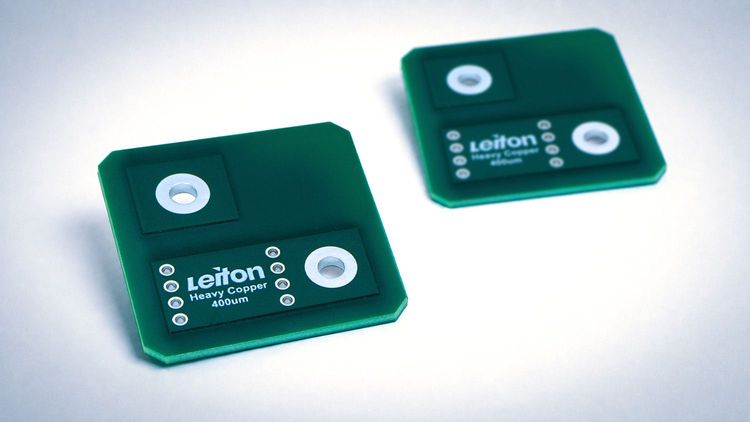
Double-sided 400 µm copper is the top class of heavy copper boards. Leiton masters the uniform etching pattern and full solder mask coverage including the copper flanks.
Heavy copper PCBs | 400 µm copper | high-current boards | thick copper PCB | PCB manufacturing
400 µm heavy copper PCBs (thick copper) for high current
400 µm heavy copper: the top class of heavy copper PCBs
PCBs with 400 µm copper on both sides are the top class of heavy copper boards. Very high currents require thick copper so that trace heating does not destroy the circuit. Two 400 µm layers can already be integrated into a normal 1.6 mm build-up. The insulation material is usually FR4 with a glass transition temperature (Tg) of 150 °C and a dielectric strength of around 3 kV per 100 µm. Other materials are possible, as the 400 µm copper layers are also in stock as pure copper.
The manufacturing challenge lies in two areas. First, the uniform etching pattern: 400 µm copper requires multiple etch passes, which create a sloping flank known as undercut. Leiton compensates for this in CAM processing (Computer Aided Manufacturing) with etch allowances of around 250 µm per flank. Second, the solder mask: a single coat does not reliably cover the high copper flanks. Leiton therefore applies the mask in several coats, each developed and cured individually. The result is a bubble-free, glossy mask surface without orange peel and with full flank coverage. Other manufacturers sometimes explicitly exclude reliable flank coverage.
An honest positioning is part of it. 400 µm copper forces coarse structures: traces from 1.2 mm width, spacings from 0.8 mm. The technology is not intended for fine signal structures. For this purpose, a multilayer construction is used, with the heavy copper placed on the inner layers. For many high-current applications, 70 to 210 µm copper is sufficient. A clear distinction also applies to copper inlays: 400 µm heavy copper is a fully laminated and etched copper layer, not a solid copper insert. The binding manufacturing limits are stated in the technology table for rigid PCBs, as these limits are continuously pushed further.
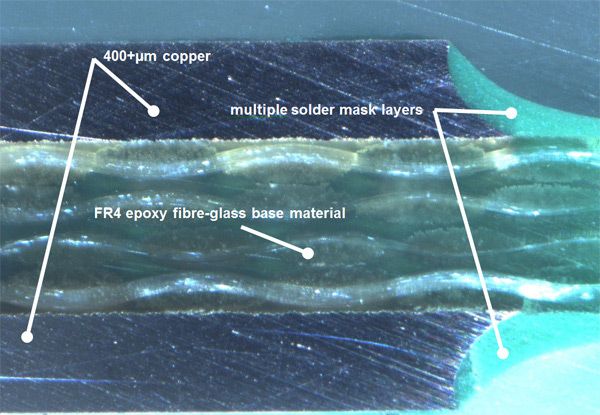
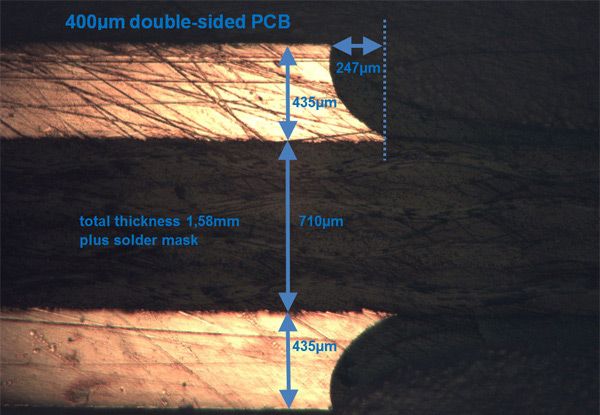
When is 400 µm heavy copper used?
If the PCB permanently carries currents in the double-digit ampere range per trace, heavy copper is the right choice. As a guide value, a 1.2 mm wide trace in 400 µm copper carries around 20 A at about 45 K self-heating. Trace heating can be calculated in our toolbox. If cables, wire jumpers or smaller soldered busbars are to be eliminated, the heavy copper layer takes over their function, as long as the cross-section of an etched 400 µm layer is sufficient. This saves components, assembly and sources of failure.
If heat losses must be spread across the area, the copper layer acts as a heat spreader. Copper conducts heat at around 380 W/mK, about a thousand times better than FR4 at around 0.4 W/mK and about twice as well as common aluminium alloys at around 150 to 200 W/mK. Pure aluminium reaches around 235 W/mK; against that, copper remains ahead by a factor of 1.6. If power stage and control are to share one board, a multilayer design is used, with the heavy copper placed on the inner layers. Since 400 µm copper is difficult to manufacture on inner layers, 2 × 200 µm heavy copper is used instead.
The reverse also holds: if the currents can be carried with wider traces in 70 to 210 µm copper, that is the more economical solution with finer structures. If heat dissipation rather than conductor cross-section is the main issue, aluminium IMS or copper IMS (IMS, Insulated Metal Substrate) are the suitable alternatives.
Applications
Power electronics and converters
inverters, DC links, power supplies and uninterruptible power supplies (UPS) with continuous currents in the double-digit to triple-digit ampere range.
E-mobility and charging infrastructure
on-board chargers (OBC), DC charging technology, motor controllers and the power path in battery management. Peak currents above 200 A are common here.
Renewable energy
solar inverters and power stages in wind turbines. Even a 5 kW inverter carries currents of 50 A and more, depending on the topology.
Drive and welding technology
servo amplifiers, frequency converters as well as welding and induction equipment with high currents in harsh industrial environments.
Planar magnetics
windings of planar transformers and storage chokes as heavy copper layers, reproducible and space-saving compared to wound components.
Combined power and control electronics
multilayers, typically with 70 µm copper on the outer layers and 210 µm on the inner layers, bring power stage and logic together on one board. This saves connectors and cabling between two assemblies.
Comparison
400 µm heavy copper versus alternatives
Heavy copper competes with thinner copper build-ups, with metal-core PCBs, with copper inlays and with classic busbars. Copper inlays are often confused with heavy copper but are a separate technology. The matrix shows the positioning.
| Solution | Typical use | When it is the right choice |
|---|---|---|
| 400 µm heavy copper (this page) | Highest continuous currents across the board area on FR4, replacement of cables and smaller busbars, heat spreading. | When standard heavy copper is no longer sufficient despite maximum trace width, or when the board is to replace cables and jumpers. |
| Heavy copper 70 to 210 µm | Increased currents at still moderate structure sizes. Up to 105 µm available in the online calculator, above that on request. | When the currents can be carried with wider traces and moderate copper thickness. Finer structures possible than with 400 µm. |
| Copper IMS | Dissipation of concentrated power losses via a solid copper core. | When heat removal is the main problem, not the conductor cross-section. |
| Aluminium IMS | Economical heat dissipation, for example for LED applications and simple power stages. | When a single-sided build-up is sufficient and cost is the priority. |
| Copper inlay PCBs | Solid copper inserts, typically from 1 mm thickness, placed locally into milled pockets and laminated in. Extreme currents and heat removal directly under the component. | When a solid copper cross-section or a direct heat sink is needed locally, beyond what an etched 400 µm layer can deliver. |
| Soldered busbars | Currents beyond PCB cross-sections, distribution in the cabinet. | When the copper cross-section of the PCB is no longer sufficient. At the cost of additional components, assembly effort and tolerance chains. |
Technical Properties
| Property | Values, explanation |
|---|---|
| Material type | FR4 Tg 150 °C with heavy copper, thickness tolerance -10/+20 % |
| Copper thickness | 200 to 400 µm |
| Overall board thickness | 1.0 mm to 4.8 mm |
| Solder mask thickness | depending on the layout between 50 µm and 250 µm per side |
| Current-carrying capacity (example) | a 1.2 mm wide 400 µm trace carries approx. 20 A at an additional temperature rise of ~45 °C |
| Thermal conductivity copper | approx. 380 W/mK |
| Thermal conductivity FR4 | approx. 0.4 W/mK |
| Thermal conductivity aluminium (for comparison) | approx. 150 to 200 W/mK (common alloys), approx. 235 W/mK (pure aluminium) |
| Maximum layer count | up to 2 layers of 400 µm on the outside, multilayer with inner layers up to 210 µm |
| Flammability | UL-94 V-0 |
Design rules for heavy copper
Traces need a base wider than their height by a factor of 2 to 3 so that they adhere safely to the base material. With 35 µm standard copper this results in minimum widths of 70 to 105 µm, with 400 µm accordingly around 0.8 to 1.2 mm. Added to this is the undercut: the multiple etch passes create a sloping flank, which is compensated with etch allowances of around 250 µm per flank. A 2 mm wide trace therefore goes into production at around 2.5 mm width. So that the etch allowances of neighbouring traces do not merge in CAM processing, correspondingly larger spacings must be observed.
| Copper thickness | Minimum trace width | Minimum spacing |
|---|---|---|
| 210 µm | 0.60 mm | 0.60 mm |
| 280 µm | 0.80 mm | 0.70 mm |
| 400 µm | 1.20 mm | 0.80 mm |
The values are excerpts. The binding and current reference is the technology table for rigid PCBs.
Advantages
- Current-carrying capacity:
a 1.2 mm wide 400 µm trace carries around 20 A at about 45 K self-heating. - Standard build-up:
two 400 µm layers can be integrated into a normal 1.6 mm build-up. - Reliable flank coverage:
multi-coat solder mask, bubble-free and without orange peel. Other manufacturers sometimes explicitly exclude this. - Heat spreading:
the copper layers distribute heat losses at around 380 W/mK and relieve the components. - Multilayer capable:
2–6 layers with 210 µm copper on the inner layers for power electronics, combined with 35–200 µm copper on the outer layers for logic and control circuitry or additional power applications.
Important notes
With 400 µm copper, minimum trace widths of 1.2 mm and minimum spacings of 0.8 mm apply. The binding reference is the technology table for rigid PCBs. The etch allowances of around 250 µm per flank are compensated in Leiton CAM processing and must be considered in the layout spacings. Due to the multi-coat solder mask build-up with up to 250 µm of mask, a thickness tolerance of -10/+20 % applies. The stated current value is a guide value; the project-specific design follows IPC-2152 (design guide for determining current-carrying capacity). 400 µm copper is manufactured on explicit request only and is not included in the online calculator. During assembly, the high thermal mass must be considered; reflow profiles and preheating need to be adapted. Compliance documents such as RoHS and REACH are available on request.
Request and calculate 400 µm heavy copper
What we need for a reliable quotation: layout data (ODB++, Extended Gerber, KiCAD or similar), copper thickness per layer, layer stackup and overall thickness with tolerance, current and temperature-rise requirements of the critical nets, quantity and schedule.
Leiton places projects where they fit best in terms of price, lead time and technology.
Why Leiton: compensation of the etch allowances in our own CAM processing, a mature multi-coat solder mask process with reliable flank coverage, engineering advice on current and thermal design, prototype to series, personal contact instead of a ticket system.
Frequently Asked Questions
about 400 µm heavy copper PCBs
- How much current does a 400 µm trace carry?
As a guide value, a 1.2 mm wide trace in 400 µm copper carries around 20 A at about 45 K self-heating. What matters is the copper cross-section of width times thickness, the permissible temperature rise and the environment. The project-specific design follows IPC-2152.
When is 70 to 210 µm copper sufficient, when is 400 µm needed?If the currents can be carried with wider traces and 70 to 210 µm copper, that is the more economical choice with finer structures. 400 µm is the solution when there is no space for wider traces, when the board is to replace cables and jumpers, or when heat spreading is needed. Up to 105 µm can be calculated online; above that, an explicit request applies.
Which minimum widths and spacings apply with 400 µm copper?Traces from 1.2 mm width and spacings from 0.8 mm, with an etch tolerance of +0/-0.25 mm. The reason is the base-to-height ratio and the undercut of the multiple etch passes. The binding reference is the technology table for rigid PCBs (internal link: /technologie-starre-leiterplatten.html).
Why does a thickness tolerance of -10/+20 % apply?The solder mask is applied in several coats; depending on the layout, 50 to 250 µm of mask per side result. Each coat is developed and cured individually. This variation goes into the overall thickness and is therefore stated as -10/+20 %.
What does undercut mean for the layout?The multiple etch passes create a sloping copper flank. Leiton compensates for this with etch allowances of around 250 µm per flank; a 2 mm wide trace goes into production at around 2.5 mm. Larger spacings must therefore be kept in the layout so that neighbouring traces do not merge after the allowance.
Can power and logic be combined on one board?Yes. The multilayer construction typically combines 70 µm outer layers with 2–6 inner layers of 210 µm copper. The power path runs through the heavy-copper inner layers, while control and signal circuitry are routed on the outer layers. This eliminates the need for a second assembly and its associated connectors. Copper thicknesses from 35–200 µm are possible on the outer layers to meet a wide range of requirements.
Does a heavy copper PCB replace the busbar?Within the limits of an etched copper layer, yes. Cables, wire jumpers and smaller soldered bars can be taken over by the 400 µm layer. If the cross-section is not sufficient, copper inlays or separate busbars are the right choice, see the comparison above.
What is the difference between 400 µm heavy copper and copper inlays?400 µm heavy copper is a fully laminated copper layer that is etched like any conductor layer and carries high currents across the board area. Copper inlays are solid copper inserts, typically from 1 mm thickness, placed locally into milled pockets and laminated in. They conduct extreme currents and heat directly under the component. Both are separate technologies; details on the copper inlay page.
What drives the cost?The copper input, the number of etch passes and solder mask cycles, panel format and quantity, plus one-time setup costs (NRE, Non-Recurring Engineering). Reliable prices result from the layout data.
Which other names are common for heavy copper PCBs?Common names are thick copper PCB, high-current PCB and heavy copper board, in German Dickkupfer-Leiterplatte and Dickkupferplatine. They all refer to the same technology with copper thicknesses from around 105 µm, here up to 400 µm.